Nepal Flood: Hot Meals, Safe Homes, Protected Children
September 03, 2026
Nepal Flood: Hot Meals, Safe Homes, Protected Children
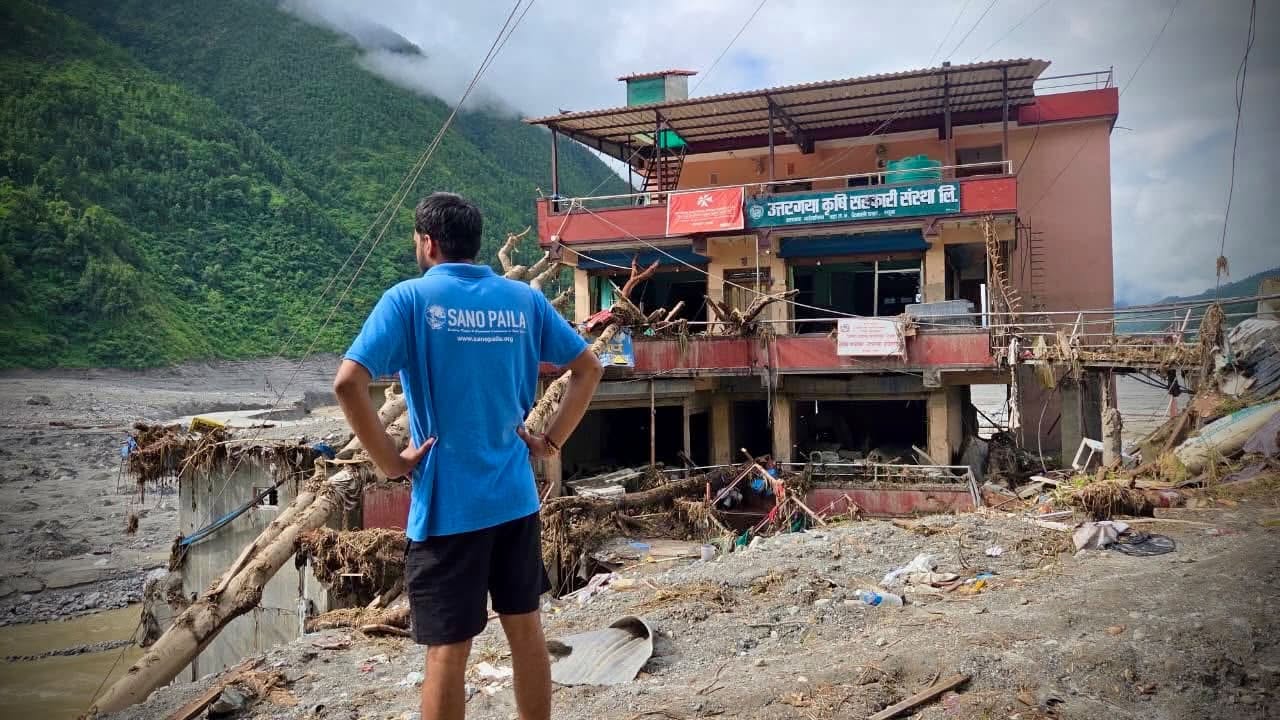
On the morning of August 26, a wall of water, ice, and rock came down from the high Himalaya and tore through Rasuwa district in Nepal. Scientists say the flood wave covered its first 22 kilometers in under seven minutes. More than 1000 people are confirmed dead across the country, and the count is still rising. Thousands are still missing. Rasuwa itself was cut off for days, with roads destroyed, power lines down, and phones dead.
Uttar Gaya Rural Municipality took some of the worst of it. Local officials estimate that around 750 people are missing from this one municipality alone. About 3,500 displaced people, among them elderly people, pregnant women, new mothers, and patients who need oxygen, are crowded into whatever shelter the local government can offer. And that local government is itself a survivor. The flood swept through the municipality compound and carried away its vehicles. The office that would normally count the losses cannot yet count its own.
Sano Paila has already begun mobilizing. Our teams are coordinating with the government to provide shelter, food, clean water, medical care, and other essential assistance. Our community kitchen in Uttar Gaya is open. It serves two hot meals a day to 300 survivors. But when our team sat down with local leaders and community groups, they learned something the news has not reported. In Bogatitar, a village in Uttar Gaya, many children are now without a parent. Their mothers and fathers were caught by the water on the morning of August 26. Some are confirmed dead. Most are simply missing, which for a child is its own kind of cruelty. There is no funeral, no answer, only waiting.
These children are sleeping in crowded shelters or with neighbors who lost their own homes and are barely holding their own families together. No adult is responsible for them. No one is there to notice when one of them goes quiet, stops eating, or wanders off. And no one is standing between them and the strangers who always come after a disaster like this one, offering work in the city or a place in a faraway school. We have spent nearly 20 years learning where those offers lead. In Nepal, separated children are among the first targets for traffickers, and the window to protect them is measured in weeks, not months.
This campaign funds our full response in one of the worst-hit areas of this disaster, from the first hot meal, which we are already serving, to medium-term recovery. We did not arrive with a plan already written. Our team sat with the community first: local leaders and community groups, the people who know every household by name and can say which family still has a roof and which does not. We asked what they needed, in what order, and what would make things worse. The plan below came out of those conversations. It is built as one connected response rather than a list of separate projects, because feeding a family that has nowhere to sleep, or sheltering a family whose children are unprotected, only solves half a problem.
Here is what we will do with your support: Two hot meals a day for 300 people. For the first 30 days, our community kitchen will serve two hot meals a day to 300 survivors. The power lines are down, so a generator will run the kitchen and the rest of the response. One dollar serves three hot meals. Keeping 20 children safe. We have spent nearly 20 years pulling children out of trafficking and exploitation in Nepal, and we know what happens to separated children after a disaster. Within weeks, strangers arrive offering work, schooling, or a home in the city. So we are opening a temporary Sano Ghar, a safe house, in Bogatitar. Two caretakers, a counselor, a cook, and a guard at the door.
Regular meals, clean clothes, health checks, school supplies, and time to play. A counselor who will not force anyone to talk about what they saw. And from the first day, family tracing with the municipality, because a safe house is a bridge, not a destination. Wherever a parent, grandparent, or relative can be found and verified, that is where a child belongs. For the children who have no safe family to return to, we will not improvise. Sano Paila already runs child welfare facilities in Birgunj and Janakpurdham, where children who have no one else grow up with care, schooling, and a future of their own. We will bring that experience to Rasuwa.
Together with the local government, we plan to open a long-term Sano Ghar in Rasuwa itself, so that no child has to leave their own district, their own language, and the relatives who may still be found, in order to be safe.
The first month of emergency care costs USD 10,345. About USD 5,240 of that is one-time setup, beds, bedding, kitchen equipment, and storage, which works out to USD 262 per child and stays with the home long after the first month. USD 5,105 is the cost of daily care, roughly USD 8.50 per child per day for food, staff, and everything a child needs to get through a day safely.
At day 30 we will report on every child and fund what each one needs next. A home for 65 families. We will build transitional shelters for 65 of the hardest-hit households, around 325 people. Each shelter has two rooms, a kitchen, and a common living space. A door that closes. A dry floor where children can sleep. The first 10 shelters will be standing by the end of September. All 65 will be finished before winter. Clean water and dignity. Eight community latrines, four for women and four for men, along with separate bathing spaces and a water supply, all designed with children, elderly people, and people with disabilities in mind. A safe place for children to learn. Two Children Learning Centers where kids can return to lessons, play, and receive psychosocial support. The flood passed in minutes. For a child, the fear does not. We will run the centers for six months, then hand them over to the local government once it is back on its feet. Recovery should end with the community standing on its own. We build for that from day one. A way to earn again. The flood took more than houses. It buried fields, drowned livestock, and swept away the tools and small trades that families lived on. A shelter keeps a family dry, but it does not feed them next spring. We will provide livelihood support to 50 of the hardest-hit farming and vulnerable households, USD 200 each. For one family that means goats or chicks. For another, seed and tools to plant the next season. For another, enough stock to reopen the small shop the water emptied. Each family decides what gets them earning again, because they know their own trade better than we do. We have done this before.
After the 2015 earthquake, our Jeevika program in Gorkha helped families rebuild their incomes through beekeeping and cold storage for their crops, and we stayed with them for years. We will bring that same approach to Uttar Gaya. Care for the most vulnerable. Health screening and outreach for pregnant women, new mothers, elderly people, and people with disabilities, in coordination with local health authorities. The clock is the season. The monsoon rains are still falling, and winter is not far behind.
Every week of delay is another week a family spends in the open. What your donation does: $1 serves three hot meals. $8.50 gives one child a full day of safe care: food, a bed, a caretaker, and a counselor. $200 buys a family goats, chicks, seed/tools, or stock for their shop, whatever gets them earning again. $262 gives one child a bed, bedding, and a place at the table. $380 puts one person under a safe roof. $517 covers one child's full first month in the safe house. $1,900 gives a family of five a home. $12,750 runs a Children Learning Center for six months.
About 89 cents of every dollar goes directly into food, child protection, shelter, water, children's recovery, and health. The rest pays for what it takes to deliver in a district with broken roads: transport, coordination, safeguarding, monitoring, and a contingency of about 2 percent. Why trust us with this. Sano Paila means a little step in Nepali. We are a Nepali organization, and for nearly 20 years we have taken those steps in the country's hardest places.
Our child protection team has rescued 424 children from exploitation and abuse and returned 405 of them to their families and communities. We run Sano Ghar, a long-term home for children who have no one else, under a Child Protection and Safeguarding Policy that governs every adult who comes near a child in our care. After the 2015 earthquake we were on the ground in Gorkha within days, and we stayed for years.
We have delivered relief to more than 120,000 families across 17 districts and served over 118,000 hot meals during the COVID crisis. Our members take no salary. Grant funding goes to programs and local Nepali staff, not headquarters overhead. In Uttar Gaya we are working directly with the Rural Municipality, district authorities, and the affected communities themselves. We stay long after the headlines move on. We are raising USD 266,366 to deliver the full plan: hot meals, one month of safe care for 20 children, shelter for 65 families, water and sanitation, two learning centers, and health support for those most at risk.
Donations are tax-deductible for US donors through Myriad USA, our trusted fiscal partner.
The water came in minutes. Recovery will take months. Help the families and children of Uttar Gaya take their next step.
Support Us: https://www.sanopaila.org/page/support-us
-1790096032.jpeg)